


Company

Utility-scale quantum computing depends on solving two core challenges: yield optimization and component integration. Qolab addresses both with system-level solutions.
Superconducting qubits remain limited by inconsistent fabrication quality. Even small variations in film thickness, junction uniformity, or material interfaces can cause significant fluctuations in coherence times and error rates. Today's fabrication technology based on lift-off is the main reason why superconducting qubits are limited to 100-200 qubits per die.
While small-scale systems can rely on selecting the best-performing qubits, scaling to thousands or millions demands reproducible, high-yield processes that traditional laboratory methods cannot provide.
At the root of the yield problem lies decoherence caused by atomic-scale imperfections. Amorphous or contaminated interfaces between metals and substrates host atomic-scale defects that act as two-level systems, absorbing energy and reducing qubit coherence.
Conventional lift-off and deposition techniques introduce oxides and impurities that prevent industrial-grade uniformity across wafers.
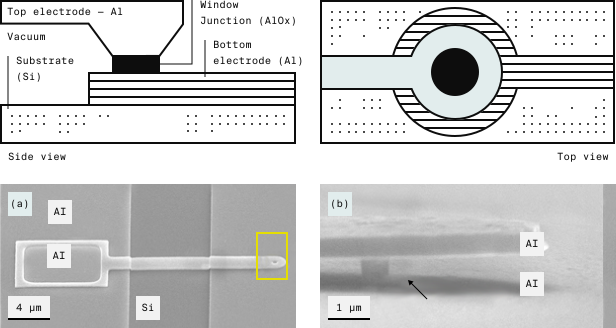
To overcome fabrication inconsistency, Qolab developed a semiconductor-compatible window-junction process that replaces lift-off steps with subtractive etching. This eliminates contamination, creating atomically clean and sharply defined interfaces.
The process scales naturally to 300 mm wafers, enabling reproducible, high-quality qubit performance across full wafers and laying the foundation for manufacturable quantum processors.

Even with improved fabrication, most quantum systems today depend on discrete components: filters, attenuators, amplifiers, and wiring connecting each qubit to room-temperature electronics. These bulky cryogenic parts take up valuable space, introduce heat, and ultimately limit the number of qubits per cryostat.
This constraint is known as CSWaP (Cost / Space / Weight / Power), with a fixed budget per cryostat. Under this architecture, scaling beyond a few thousand qubits per dilution refrigerator becomes physically and economically infeasible.
The CSWaP challenge existed in traditional electronics as well. It wasn’t until the invention of the integrated circuit that all wires, transistors, and other components were miniaturized onto a single system.
Today, if an NVIDIA Grace Blackwell chip were built using discrete components, it would require 600,000 km of wiring and cost over $1 trillion to operate due to power consumption.
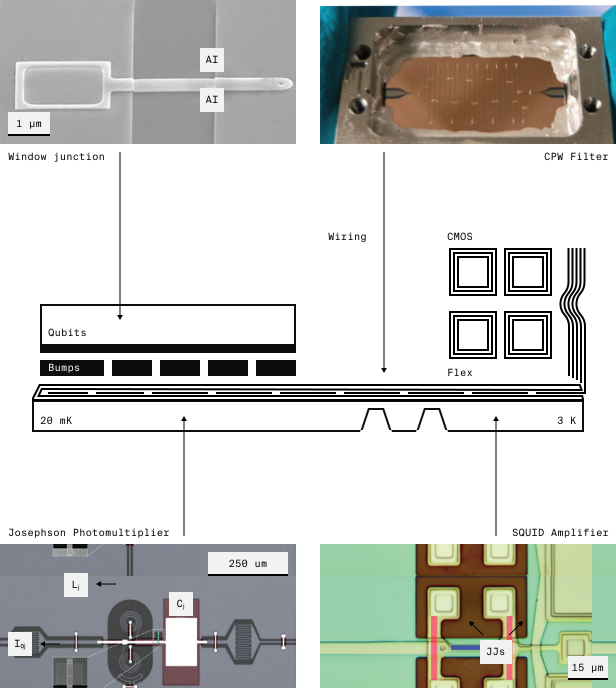
To overcome the limits of discrete components, Qolab adapts Wafer-Scale Integration and Chip-on-Wafer-on-Substrate (CoWoS) techniques from the semiconductor industry for cryogenic systems. The goal is to enable up to 100,000 qubits per dilution refrigerator — roughly 100× today’s density at a fraction of the cost.
Routes signals from 3 K to 20 mK, reducing heat load and eliminating bulky coaxial wiring
Embeds coplanar waveguide low-pass filters, removing Eccosorb filters and microwave attenuators
Integrates Josephson photomultipliers and SQUID amplifiers, replacing traveling-wave amplifiers and circulators
The qubit and wiring wafers are bonded into a single tiling module, then capacitively coupled with neighboring modules to form compact, modular systems with significantly lower cost and improved thermal efficiency.

%201.svg)